How carbon-graphite vanes are made
Graphite
vanes
Technology for dry-running vacuum pumps and compressors
Video without a playback bar; use the pause button to stop it
What happens
Raw materials are crushed and ground to obtain particles of the intended size. They are then separated by size, for example using sieves. This selection is called classification; the resulting range of sizes is the particle size distribution.
What it is for
Particle size influences how particles pack together and the material structure. It is controlled to prepare a reproducible mixture with the proportion of fine and coarse particles required by each grade.
What it contributes to the vane
This preparation forms part of the foundation of the material that will later be machined. It helps control its properties and response to finishing. Choosing a technical carbon-graphite means understanding its composition and structure as well as its external dimensions.
Video without a playback bar; use the pause button to stop it
What happens
Particles need a component to hold them together: the binding agent or binder. It provides the bond within the mixture. Some routes use pitch, a binder that softens with heat; others use a synthetic resin, depending on the material required.
What it is for
The binder allows the mixture to be shaped and influences subsequent treatments. Pitch can be converted into carbon by heating. A resin can harden through curing, a different process that preserves its binding function.
What it contributes to the vane
The type of bond influences the material’s strength and thermal limits. A resin-bonded graphite and a carbon produced through carbonisation may therefore require different service conditions, even when the parts look similar.
Video without a playback bar; use the pause button to stop it
What happens
Carbon and graphite particles are mixed with the binder in the defined proportions. The equipment distributes the components throughout the mass and, when the formulation requires it, supplies heat to help mixing.
What it is for
The aim is a composition that is as uniform as possible throughout. Dosing determines how much of each component is added; the mixing process determines their distribution. Both are adjusted to the grade being produced.
What it contributes to the vane
A uniform mixture helps produce a material that behaves consistently throughout the part. This is a check before machining: achieving the correct vane dimensions starts with a suitable, properly prepared material.
Video without a playback bar; use the pause button to stop it
What happens
The prepared mixture is pushed through a die: a tool whose opening shapes the emerging material. This produces an elongated profile, such as a bar, which can be cut into blanks.
What it is for
Extrusion shapes the material and can orient its particles in the direction of flow. That orientation influences its properties. It is an alternative to moulding and isostatic pressing; the appropriate route is chosen for each grade.
What it contributes to the vane
The resulting profile must still undergo the treatments and operations specified for that material. It is then machined to achieve the vane’s geometry. Extrusion defines an initial shape, not the final installation dimensions.
Video without a playback bar; use the pause button to stop it
What happens
The mixture is placed in a mould and compacted to form a block or blank. In die pressing, it is compressed using tooling; in vibration moulding, vibration helps particles settle. These are different forming methods.
What it is for
Compaction means bringing particles closer together and arranging them within a shape. Density is controlled: the mass contained in a given volume. The method can also influence particle orientation and material properties.
What it contributes to the vane
The resulting part may already have a recognisable shape, but its manufacture is not yet complete. The specified treatments and subsequent machining produce the material and dimensions required by the vane.
Video without a playback bar; use the pause button to stop it
What happens
The mixture is placed in a flexible mould inside a chamber. A fluid transmits pressure around the mould and compresses the material from every direction. This is isostatic pressing: uniform pressure around the part.
What it is for
Distributing pressure aims to achieve uniform compaction and more similar properties in the different directions of the block. This characteristic is called isotropy. The actual result depends on formulation and process control.
What it contributes to the vane
This route can prepare certain materials with a homogeneous structure for subsequent machining. It is another forming option: selection depends on the grade and properties needed, rather than every vane having to undergo this process.
Video without a playback bar; use the pause button to stop it
What happens
In routes using a carbonisable binder, the part is heated in a furnace under a controlled atmosphere without oxygen. The binder converts into carbon and consolidates the bond between particles: this is carbonisation.
What it is for
Gases escape during heating and may leave small pores inside the part. The temperature and heating and cooling rates are controlled to obtain the intended structure. The material changes internally even if it retains a similar shape.
What it contributes to the vane
The conversion of the binder helps consolidate the carbon body. It differs from curing a resin, which hardens the binder without converting it into carbon. Each material undergoes the treatment appropriate to its formulation.
Video without a playback bar; use the pause button to stop it
What happens
In grades that require it, a resin penetrates the open pores: small voids connected to the outside. A vacuum and pressure cycle may extract air and help the resin enter; the resin is then hardened by curing.
What it is for
Filling these voids reduces how easily a fluid passes through the material: its permeability. The resin may also change its mechanical behavior. It is selected for the application’s operating conditions.
What it contributes to the vane
In a vane, impregnation adjusts the properties of an already formed material; it differs from using resin as the initial binder. The grade’s manufacturing route determines when it is applied. Other treatments use salts or metals. The vane specification identifies which treatment it incorporates.
Video without a playback bar; use the pause button to stop it
What happens
In certain synthetic graphite routes, the material undergoes a treatment that can reach around 3,000 °C. The carbon structure reorganises into a more ordered arrangement characteristic of graphite. This change is called graphitisation.
What it is for
This reorganisation changes thermal conductivity, the ability to transfer heat, and sliding behavior. It may also change hardness and mechanical strength. It is used when these characteristics suit the grade being produced.
What it contributes to the vane
This treatment helps define material behavior but does not apply to every grade. The 3,000 °C refers to the manufacturing furnace; a vane’s permissible service temperature depends on its material and the equipment conditions.
Video without a playback bar; use the pause button to stop it
What happens
At HARDVANES, we machine the selected material to produce the vane for each reference. We work on length, width and thickness, together with the bevels, grooves and profile required by the design. The specified dimensions are the measurements defined for the part.
What it is for
The vane must slide in its rotor slot and work correctly against the equipment interior. Both dimensions and tolerances matter: tolerances define the permitted variation. An incorrect fit can restrict movement or increase internal leakage.
What it contributes to the vane
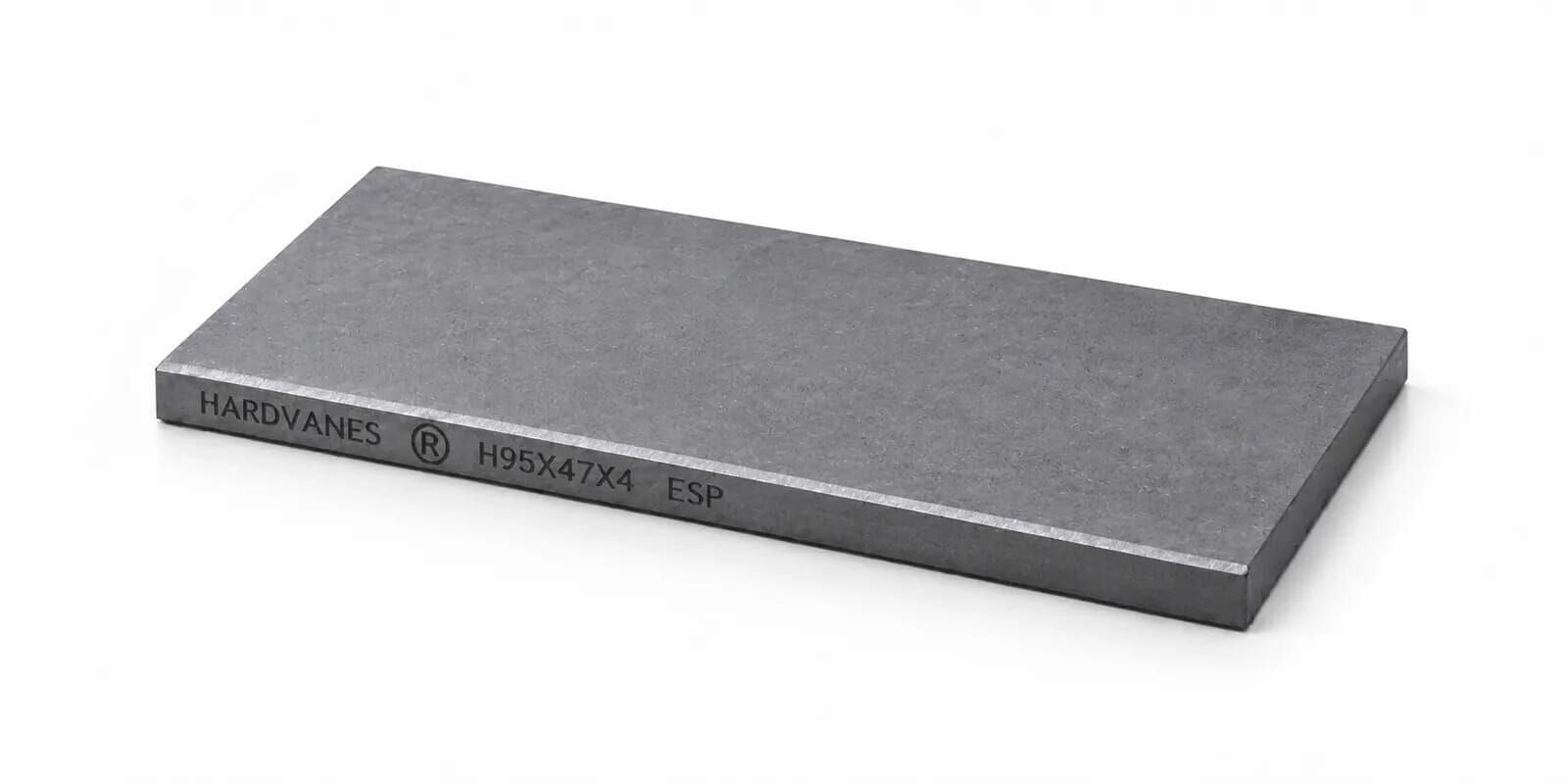
Machining in Spain is completed with polishing and a mirror finish, followed by inspection. Dimensions, faces, grooves and edges are checked against the reference so that material and geometry match the vacuum pump or compressor.
Video without a playback bar; use the pause button to stop it
How a vane works
The rotor turns. The vanes slide. Air enters, moves through and leaves the pump.

Air enters
As a chamber’s volume increases, air enters through the inlet.
The rotor moves it
The vanes follow the rotation and keep the working chambers separate.
Air leaves
The reduction in volume compresses the air and directs it towards the discharge.
Vanes slide in the slots of a rotor mounted eccentrically inside the cylinder. As it turns, they separate chambers that expand and contract: this is how air enters, moves through and leaves the equipment.
In a machine designed to run dry, carbon-graphite allows this contact without adding oil to the chamber.
Under vacuum
Suction holds parts, handles materials or extracts air.
Under pressure
The outlet air is used for blowing, separating or aerating. Combined units provide both functions according to their design.
Vanes have several common names; in Spanish these include «paletas», «aspas», «palas», «aletas» and «álabes». They are also searched for as carbon vanes or graphite vanes. The equipment reference and model identify the replacement.
Technical carbon‑graphite
The compound, geometry and operating conditions are selected together.
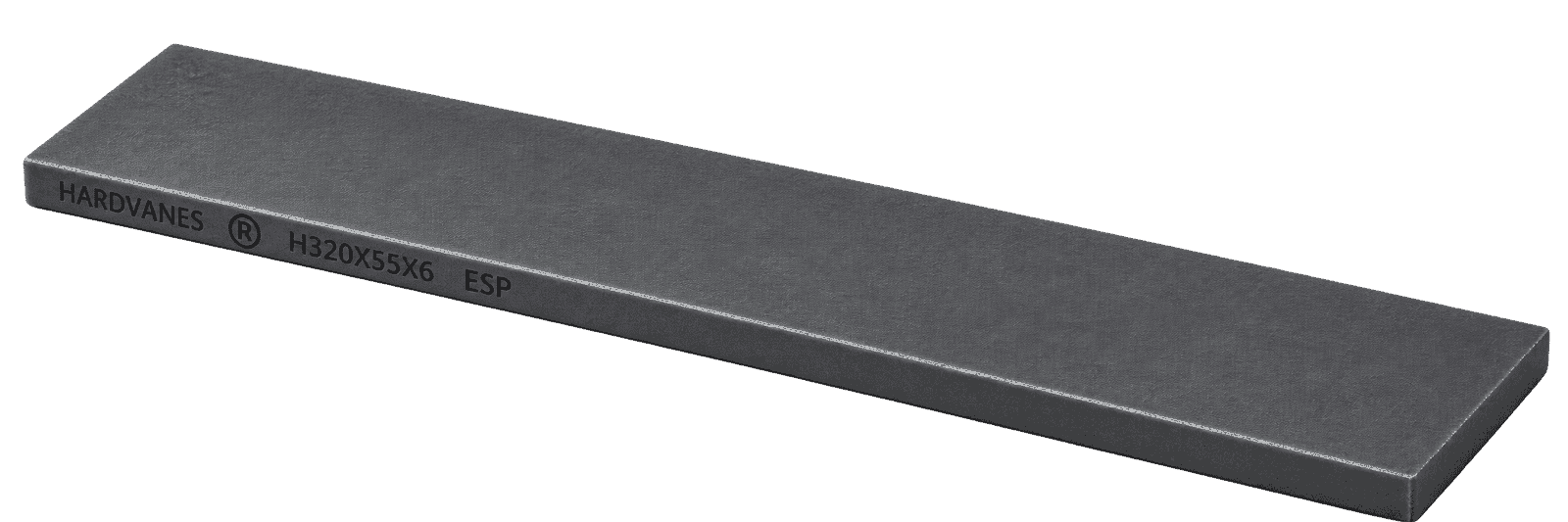
HARDVANES®
EKVAC EVO+
Machined and polished in Barcelona
Dry sliding
The graphite structure helps surfaces slide against one another. In technical carbon-graphite, formulation and finish are matched to the vane’s function.
Formulation matters
EKVAC EVO+ is the synthetic resin-bonded reference grade described here. The binder is part of the material; it is not equivalent to subsequent impregnation.
The contacting material pair, clearances and temperature also influence behavior. Special series have their own specifications.
For lubricated equipment or fibre, G11 and aramid materials, we select the specification appropriate to the equipment.
View all ten propertiesMaterial data
Ten reference properties of EKVAC EVO+, with their units and an explanation of each.
Coefficient of friction μReference value dependent on the contacting material pair and the test and service conditions.
Contact and structure
- Coefficient of friction μ
- 0.069
- Describes resistance to sliding. Depends on the contacting material pair and test and service conditions.
- Density
- 1.73 g/cm³
- Relates mass to volume. A property of the reference material.
- Rockwell hardness
- 80 HR 5/100
- Describes resistance to indentation in a hardness test. The value applies to the stated scale and must not be compared with other scales without a valid conversion.
- Open porosity
- No, according to the technical data sheet
- Refers to pores connected to the outside. It does not alone guarantee the leak tightness of the pump assembly.
Mechanical behavior
- Flexural strength
- 80 MPa
- Describes resistance to fracture when the material bends. Equivalent to 80 N/mm²; it is not the permissible load of an installed vane.
- Compressive strength
- 120 MPa
- Describes resistance under compressive stress. Impacts can damage the part even when the material withstands compression.
- Modulus of elasticity
- 22 GPa
- Equivalent to 22,000 N/mm² and characterises stiffness.
Thermal behavior
- Thermal conductivity
- 6 W/(m·K)
- Indicates the ability to transfer heat. Do not replace it with a generic value for another graphite.
- Thermal expansion
- 11 × 10⁻⁶ K⁻¹
- Indicates dimensional change with temperature. The specific documented range is 20–150 °C; the technical data sheet uses a general heading of 20–200 °C.
- Short-term maximum temperature
- 180 °C
- Short-term maximum for the reference material, not the pump’s operating setpoint. Prolonged exposure may change its properties.
Typical reference material values for dry-running carbon-graphite vanes. The specification for your HARDVANES code confirms the grade supplied.
Request the specification for my referencePolishing and mirror finish
From material to finished vane: geometry, surfaces and part inspection.
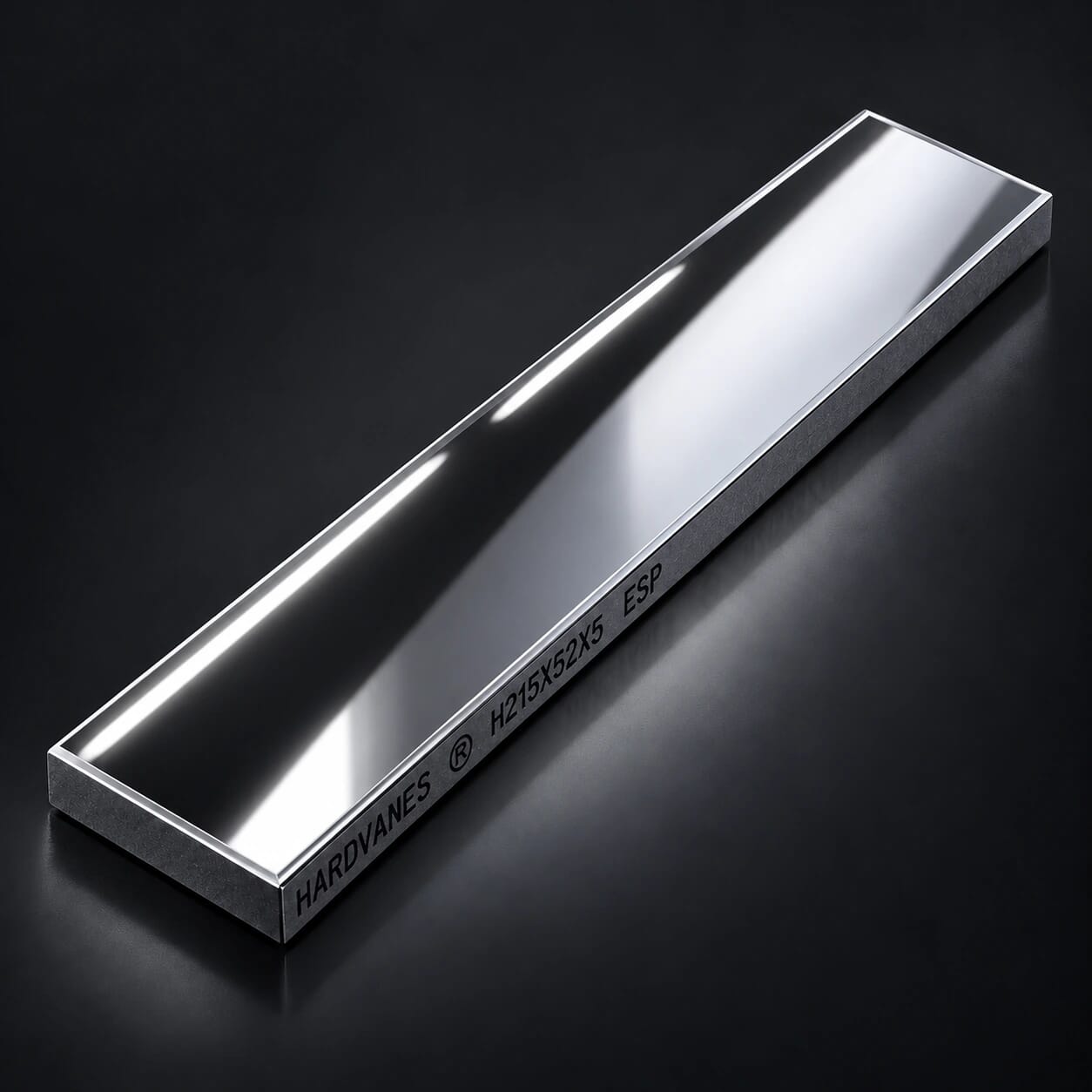
Defined geometry
Length, height, thickness, profile and functional details are machined according to the reference or approved drawing.
Carefully finished surfaces
Flatness, parallelism, roughness and edges are assessed alongside polishing. Shine alone does not determine vane service life.
Part inspection
We check dimensions, profile and face condition before identifying and protecting the set.
Geometry matters
Dimensions define the starting point. Profile, tolerances and material complete the compatibility requirements.
Runs along the rotor axis and determines vane length inside the slot.
Allows the vane to extend out of the slot towards the cylinder wall.
Affects fit and sliding inside the rotor slot.
Bevels, grooves and orientation also matter. Matching three dimensions does not alone confirm the replacement. Nor can a worn vane reveal all its nominal dimensions.
Vacuum and pressure
Ten applications for rotary vane pumps, compressors and combined units. Each machine requires its own material and reference.
Printing and paper
Suction picks up and transports sheets; blowing air separates and guides them. Rotary vane pumps, compressors and combined units are used in feeders, printing and finishing.
Vacuum and pressureCNC woodworking
Holding boards and workpieces on vacuum tables during milling and cutting. Vacuum keeps the workpiece against the working surface while the tool operates.
VacuumPackaging and secondary packing
Opening boxes, forming trays and handling bags, containers and cartons. Vacuum-operated suction cups are used in forming machines, case packers, filling machines and palletisers.
VacuumRobotics and pick & place
Picking up, transferring and placing parts using suction cups. Rotary vane pumps supply vacuum to manipulators and automatic loading and unloading systems on production lines.
VacuumElectronics and semiconductors
Handling components and circuit boards, and securing parts during manufacturing and testing. Vacuum helps hold small items and position them at automated stations.
VacuumPlastics thermoforming
Forming heated plastic sheets over a mould to produce trays, housings and other parts. Suction draws the sheet against the tooling geometry.
VacuumTextile and leather cutting
Holding fabrics and leather on suction cutting tables. Vacuum keeps the material against the support surface during cutting and automated processing.
VacuumHospitals and medical equipment
Generating vacuum in central suction systems and medical devices incorporating rotary vane pumps. The pump provides the suction required by the equipment or central installation.
VacuumLaboratory and air sampling
Taking air samples and generating vacuum in laboratory equipment. Rotary vane pumps also serve processes such as drying and distillation, depending on instrument design.
VacuumWater aeration
Supplying air to pond aeration and wastewater treatment systems. Rotary vane compressors deliver air to the installation’s diffusers.
PressureCare for the complete assembly
Service life depends on the vane and how the machine operates.
Rotor and cylinder
A new vane does not correct damaged surfaces. Slot, chamber and clearance condition determines contact.
Filtration and cooling
Particles and excess heat affect operation. Check filters and ventilation at the intervals specified for your equipment.
Wear and installation
Check the wear limits, profile and orientation specified by the model’s manufacturer. Vane material and fit are considered together.
Find answers to your questions
Material, equivalents and conditions of use: questions that help identify the correct vane.
View all questionsMaterial and operation
What do vanes do in a vacuum pump or compressor?
They slide in the rotor slots and help form chambers whose volume changes during rotation. This displacement draws in, compresses and expels air. The pump uses suction and the compressor supplies pressurised air, according to each unit’s design. Material, dimensions and contacting surface condition influence operation of the assembly.
What does it mean for a graphite vane to be self-lubricating?
Its material allows the contacting surfaces to slide without adding oil to the chamber of a machine designed to run dry. Carbon-graphite formulation, finish and equipment conditions are considered together.
What is the difference between vanes described as «carbón», «carbono» and «grafito»?
These commercial descriptions may cover different formulations. They do not alone identify the grade or binder type. Choosing a replacement requires its specification and application; two black parts of equal dimensions may behave differently.
Can electrical brush graphite be used to make vanes?
Appearance does not establish suitability. An electrical brush performs a different function. A vane requires a material specified for mechanical contact, sliding and conditions inside the pump.
Do all HARDVANES vanes use the same compound?
Selection is confirmed for each reference. The values here are a technical reference and must not be attributed to every vane, special series or application. Request the specification for your HARDVANES code.
Names and compatibility
Do vanes, blades, fins and similar names mean the same thing?
Yes, they can refer to the same part in rotary vane vacuum pumps and compressors. Names vary by country, manufacturer and workshop terminology; in Spanish these parts may be called «paletas», «aspas», «palas», «aletas» or «álabes». When made from carbon-graphite, they are also searched for as graphite vanes, carbon blades or carbon parts for vacuum pumps.
They are also searched for as carbon vanes, carbon graphite vanes or vacuum pump vanes; a complete replacement set is often listed as a vane kit.
These names are not equivalent in every machine. A fan or turbine blade is not a sliding vane in a vacuum pump. To identify the replacement correctly, always relate its name to the equipment it belongs to.
What vanes do inside the pump
Vanes sit in the rotor slots and slide as it turns inside the cylinder. Contact with the inner wall separates the working chambers that move air. This mechanism is used in vacuum pumps, rotary vane compressors and combined vacuum and pressure units. Part accuracy and fit contribute to operation of the assembly.
Names you may find when searching for these parts
| Term | Meaning in this context |
|---|---|
| Vanes, rotary vanes or sliding vanes | Identify the parts that move inside the rotor slots |
| Vacuum pump blades («aspas» or «palas» in Spanish) | Other names for these vanes when searching for or requesting a replacement |
| Fins or blades for pumps and compressors («aletas» or «álabes» in Spanish) | May identify the same parts, provided the equipment uses sliding vanes |
| Graphite vanes, carbon vanes or carbon blades | Refer to the part’s material, but do not alone identify its exact composition or compatibility |
| Carbon parts for vacuum pumps («carbones» in Spanish) | A description requiring more information, because «carbones» may also mean other components |
| Spare parts or replacements («refacciones», «repuestos» or «recambios» in Spanish) | General replacement terms that may include vanes, filters, seals, bearings and other components |
Spanish search terms include aspas de carbón para bombas de vacío, paletas de grafito or recambios para bombas de vacío. Adding brand, model and reference helps establish the part you need.
English terms include carbon vanes, graphite vanes, vacuum pump vanes and compressor vanes. The first two refer to material; the others indicate use in a vacuum pump or compressor. None identifies a compatible reference on its own.
Are all vanes made from carbon or graphite?
No. Material depends on equipment design and operating conditions. Carbon-graphite is used in many dry-running rotary vane pumps and compressors. Fibre vanes and other materials also exist for equipment with different requirements, including oil-lubricated models.
Requesting a «graphite vane» is a starting point, but the correct material grade for the model and application must be checked. Likewise, a fibre vane must not be replaced by carbon-graphite simply because their dimensions appear to match.
Are carbon vanes the same as motor brushes?
No. They are different components with different functions.
Pump vanes move air inside the working chamber. Carbon brushes, used in certain motors and generators, are contacts carrying electrical current between stationary and rotating parts. Sharing a carbon-based material does not make them interchangeable.
If searching for «carbons» or «carbones», specify whether you need vanes for the vacuum pump or brushes for the electric motor.
How to identify the correct vane for your equipment
To confirm the replacement, check:
- Brand, full model and equipment variant, exactly as shown on the nameplate.
- Part or vane set reference, original or an alternative with verified compatibility.
- Dimensions and geometry: length, width, thickness, tolerances, bevels and grooves where applicable.
- Material and specific grade, suitable for that equipment.
- Service conditions: dry or lubricated operation, vacuum, pressure or both, and application requirements.
Variants of the same model may need different sets. A used vane may have lost material through wear: measurements help identify it but must be checked against the replacement specification.
We help you find your HARDVANES® vanes
You do not need the exact technical term to ask us. Send a photograph of the equipment nameplate, the available reference and photographs of the vanes with their dimensions. These details let us check the replacement for your vacuum pump or compressor.
Whether you call them vanes, blades or fins, what must match is the specification your equipment requires.
Which details help identify the replacement?
Provide brand, full model and vane or equipment reference. If you have measurements, include length, height, thickness, bevels and grooves. Add vanes per set, number of sets and destination so we can review supply.
Can a worn vane be copied?
A used part helps identify the profile, but wear may have reduced its dimensions. It cannot alone establish all nominal dimensions. The equipment reference and, where appropriate, an approved drawing define the geometry, tolerances and material needed for the new vane.
Are two vanes with the same dimensions interchangeable?
Not necessarily. Material grade, profile, bevels, grooves, tolerances and application must also match. Check the full model, variant and replacement reference.
Can dry-running graphite vanes be used in a lubricated pump?
Dry-running suitability must not be extrapolated to an oil-lubricated pump. The reference, material and specified conditions for that model must match. Do not add oil to a chamber designed to run dry.
Temperature, finish and process
What temperature can a carbon-graphite vane withstand?
It depends on the supplied material and pump limits. The table lists 180 °C as the reference material’s short-term maximum; prolonged exposure may change its properties. The approximately 3,000 °C of some graphitisation routes is a manufacturing temperature, not this vane’s service temperature.
Does a mirror finish guarantee longer service life?
Finish must meet the part specification and requirements of contact inside the pump. Shine alone does not demonstrate better performance. Roughness, flatness, parallelism, edges and fit are also assessed.
Does every vane follow all eleven scenes?
No. The scenes illustrate different industrial material manufacturing techniques. Forming methods are alternatives and treatments depend on the grade. The applicable route is confirmed for the manufactured reference.

From Spain to your equipment
We supply vanes for vacuum pumps and compressors with shipping to Spain and international destinations.

Shipping within Spain
We ship your vanes with GLS.

International shipping
DHL Express Priority, depending on destination.
Provide reference, quantity and postcode to confirm availability, transport and lead time. Where manufacturing is required, its lead time is confirmed separately from transit.
We handle carbon vane and spare part inquiries with shipping to Spain and international destinations. Shipping conditions and, where applicable, import conditions are detailed in the quotation.
Find your vane
Search the catalog or send your vacuum pump or compressor details. We help confirm the reference and supply.
- Brand and model
- Reference or dimensions
- Quantity and destination
Content updated on · HARDVANES®